
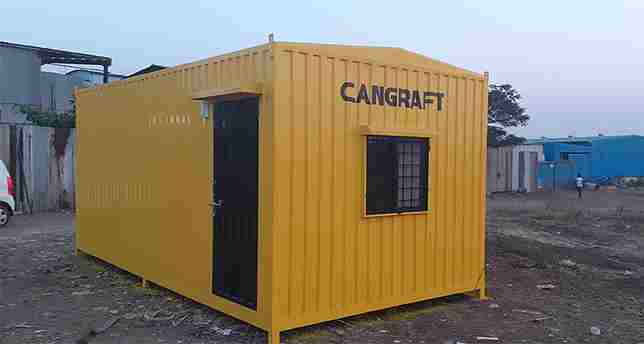
Quick take
If the requirement is speed, flexibility, lower upfront cost, and the option to relocate or reuse the structure, portable cabins often make more practical sense than conventional construction.
In many industries, the real problem is not lack of land or lack of demand. The real problem is the time and cost required to create functional space. Traditional construction is slow, labour-heavy, and often unsuitable when a project needs to begin immediately. Portable cabins solve this gap by offering ready-to-use, adaptable spaces that can be deployed much faster.
At PI Porta Cabins, the focus is on building practical modular structures that match actual usage. That may mean a site office for engineers, a control room for operations, a guard cabin for access control, a portable toilet block for labour facilities, or a farmhouse unit for weekend use. The value comes not from appearance alone, but from how efficiently the structure performs in real conditions.
Portable cabins are not simply “temporary structures”. In many cases, they are the fastest and most economical way to create operational space without locking capital into full civil construction.
Understanding the main types of portable cabins
Not all cabins serve the same purpose. A buyer choosing only on price usually makes the wrong decision. The right cabin depends on use, duration, location, exposure, and functional requirements.
Portable Office Cabin
Suitable for project offices, temporary admin setups, and site-based coordination teams.
Steel Portable Office Cabin
Preferred where stronger structure and longer-term use are important.
MS Portable Cabin
A cost-conscious option for standard industrial and commercial applications.
Modular Portable Cabin
Useful where expansion, combination, or layout flexibility is needed.
GI Portable Cabin
Better suited for outdoor exposure where corrosion resistance matters.
Portable Toilet Cabin
Important for construction sites, events, workforce accommodation, and remote locations.
GI Security Guard Cabin
Compact, sturdy, and suitable for entry gates and controlled access points.
GI Control Panel Cabin
Designed to house technical systems and electrical control infrastructure safely.
What makes a portable cabin worth buying?
A good portable cabin is not just about a fabricated shell. It must work well in daily operations. Buyers should evaluate structure, insulation, usability, maintenance demand, and how well the cabin matches the site environment.
Durable construction
Quality materials and proper fabrication improve working life and reduce avoidable repairs.
Fast deployment
One of the biggest advantages is speed. Cabins become usable far faster than conventional builds.
Design flexibility
Layouts can be configured for offices, living space, control areas, toilets, or utility use.
Lower maintenance
Well-built units are easier to maintain and can stay serviceable for years with basic care.
Why businesses increasingly choose portable cabins
The shift toward modular structures is not just a trend. It is a practical response to cost pressure, faster project cycles, labour constraints, and the need to create usable infrastructure without delay.
- Time savings: Projects can begin operations much earlier.
- Cost efficiency: Lower civil work and reduced construction dependence.
- Reusability: Units can often be moved and reused across multiple sites.
- Flexibility: Suitable for short-term, medium-term, or even long-term use depending on design.
- Operational convenience: Offices, toilets, security points, and technical spaces can be added quickly.
Practical decision rule
If the structure needs to be operational quickly, may need relocation later, and does not justify full civil construction, portable cabins are usually the more efficient option.
Where portable cabins are most commonly used
Portable cabins are used wherever infrastructure has to be created quickly and used efficiently. Their applications extend far beyond construction sites.
Customization matters more than most buyers realise
A cabin performs best when it is designed around actual use rather than chosen from a generic specification. Size alone is not enough. The internal function of the space matters.
Structural customization
- Custom dimensions
- Material selection based on environment
- Single or modular configuration
- Mobility planning for relocation
Functional customization
- Partitions and internal layout
- Electrical fittings and lighting
- Insulation and ventilation
- Doors, windows, furniture, branding
Basic maintenance that protects long-term value
Portable cabins are relatively easy to maintain, but neglect reduces both performance and life. A few simple practices go a long way.
- Clean surfaces and prevent long-term dirt build-up.
- Inspect joints, exposed edges, and corners for rust or wear.
- Check electrical points and fittings regularly.
- Maintain ventilation and ensure water does not stagnate nearby.
- Keep doors, windows, locks, and seals in proper condition.
Why PI Porta Cabins
The real difference comes from building cabins around practical usage, not just fabrication speed. PI Porta Cabins focuses on solutions that are durable, configurable, and relevant to actual project requirements.
Frequently asked questions
What is the life of a portable cabin?
With proper fabrication quality and basic maintenance, portable cabins can remain serviceable for many years.
Are portable cabins suitable for outdoor use?
Yes. Material choice and finishing can be planned according to weather exposure and site conditions.
Can portable cabins be moved later?
Yes. Relocation is one of their major practical advantages when planned correctly.
Can the cabin be customised?
Yes. Size, internal layout, fittings, windows, doors, insulation, and finish can be tailored to need.
Are they only for temporary use?
No. They can serve both temporary and longer-term needs depending on design and intended use.
Final thought
Portable cabins make the most sense when speed, flexibility, and practical economics matter. For many projects, they are not a compromise. They are the smarter infrastructure decision.